Two Years of AI: What We Learned from 2024 to 2026
Two Years of AI
: What we learned from 2024 to 2026
Two years is a long time in AI.
Since our first ebook in 2024, models have become faster, more capable, more accurate and dramatically better at reasoning, coding, generating content and interacting with tools. What felt experimental two years ago is now embedded in everyday products and workflows. AI assistants have moved from novelty to infrastructure.
And yet, the most interesting question is no longer “How powerful are the models?”
It is: What have we actually learned?
The AI race has evolved in ways that were difficult to predict in 2024. The dominant narrative was once relatively simple: a small number of frontier AI laboratories would race toward increasingly capable, and eventually superhuman systems, while building one-man billion dollar businesses with access to that intelligence.
That narrative has become much less convincing. The rise of open-weight models from China, the endless investment and capabilities of Google and Meta, and the willingness of companies such as SpaceX to pursue AI for strategic reasons that do not fit neatly into the traditional software business model have created a much more competitive landscape.
Instead of one or two laboratories inevitably pulling away from everyone else, we may be entering a world with five, six, or even seven serious frontier AI players .
That changes the question. The story of the last two years is therefore not simply a story about increasingly intelligent machines. It is a story about how humans have adapted to them and how our assumptions about AI have changed along the way.
SOFTWARE ENGINEERING
& DEVELOPMENT
We build robust, scalable software that performs under pressure. From microservices to monoliths, our engineering teams deliver production-grade code.
Two years later, the picture is clearer, but not simple
Looking back from 2026, the most important change may not be that AI became smarter. It is that our understanding of what intelligence means in the workplace, in society and in technology has become more nuanced.
This reading is an attempt to capture those nuances while working in Retail & Luxury sector, not another celebration or condemnation of AI. After everything we have learned, what does AI actually mean for the way we work, think, decide and build? Instead, it is a look back at two years of atomic changes.
Some figures
1/ AI and Technology
Agentic AI and MCP explained
AI has moved through three distinct stages.
Sitting underneath this shift is a new piece of infrastructure: the Model Context Protocol (MCP) . If Agentic AI is the "brain" deciding what to do, MCP is the standardised wiring that lets that brain actually plug into the outside world (databases, apps, files, APIs) without a custom cable for every device.
This piece walks through what each of these terms actually means, how they fit together, and why MCP is becoming a big deal.
AI Agents vs. Agentic AI: a real distinction
These two terms get used interchangeably, but they describe different things.
- AI agents are built to perform a defined task. Think of Siri scheduling a calendar event, or a bot that automatically processes incoming invoices. They're competent within a lane, but they don't really improvise outside it.
- Agentic AI is the broader idea: systems that take initiative, adapt when circumstances change, and make decisions even with incomplete information. Closer to how a human employee would handle an open-ended assignment. An AI agent might be one component inside an Agentic AI system, but Agentic AI describes the overall approach: goal-oriented, proactive, and able to improvise.
A simple way to remember it: an AI agent executes a task; Agentic AI pursues a goal.
Below, 2 examples:
01 Fraud Detection +
In finance, a system that detects a fraudulent transaction and automatically freezes the account, rather than just flagging it for a human.
02 Routing last minute changes +
In supply chains, a system that reroutes shipments in real time based on live demand and disruption data.
How does an AI agent actually reach real-world data?
Here's the practical problem. An agent that can reason brilliantly is still useless if it can't check today's flight prices, pull the latest sales numbers, or post a message to Slack alone. Historically, every one of those connections required its own custom integration: a different API or connector for every tool.
That's the gap MCP was built to close.
What MCP actually is
The Model Context Protocol , introduced by Anthropic, is a standardised way for AI models to connect to external tools and data sources.
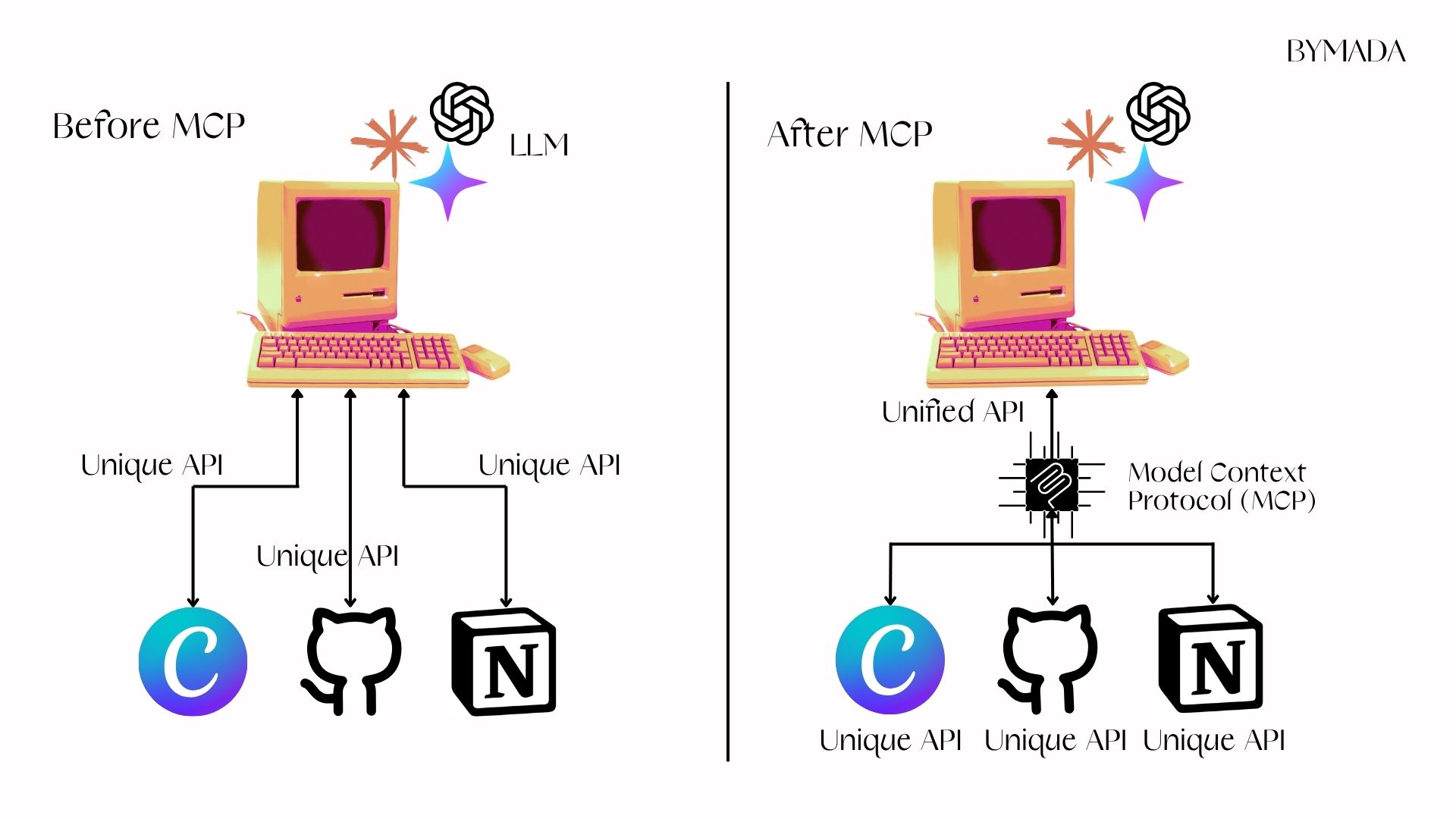
MCP servers expose three main kinds of capability:
- Resources :readable data, roughly equivalent to a GET request (a file, a database record, an API response).
- Tools :functions the AI can actually call to take an action, roughly equivalent to a POST request (send an email, update a record, trigger a workflow).
- Prompts :reusable templates that help structure how the AI approaches a specific task.
Importantly, MCP doesn't replace APIs , it sits on top of them. It's a higher-level protocol that organises and standardises how those APIs get used, so a connector built once (say, for Notion) can be reused across many different AI applications instead of being rebuilt from scratch each time.
How MCP and Agentic AI work together?
You can think of it as a simple loop. Each cycle, the agent decides what it needs, connects to the right tool, executes the action, then folds the result back in and repeats until the goal is met.
In short: Agentic AI is the behavior layer (it sets goals and plans steps), and MCP is the execution layer (it lets the agent actually act on those plans safely and consistently).
The architecture behind it
MCP runs on a client-server model with three parts:
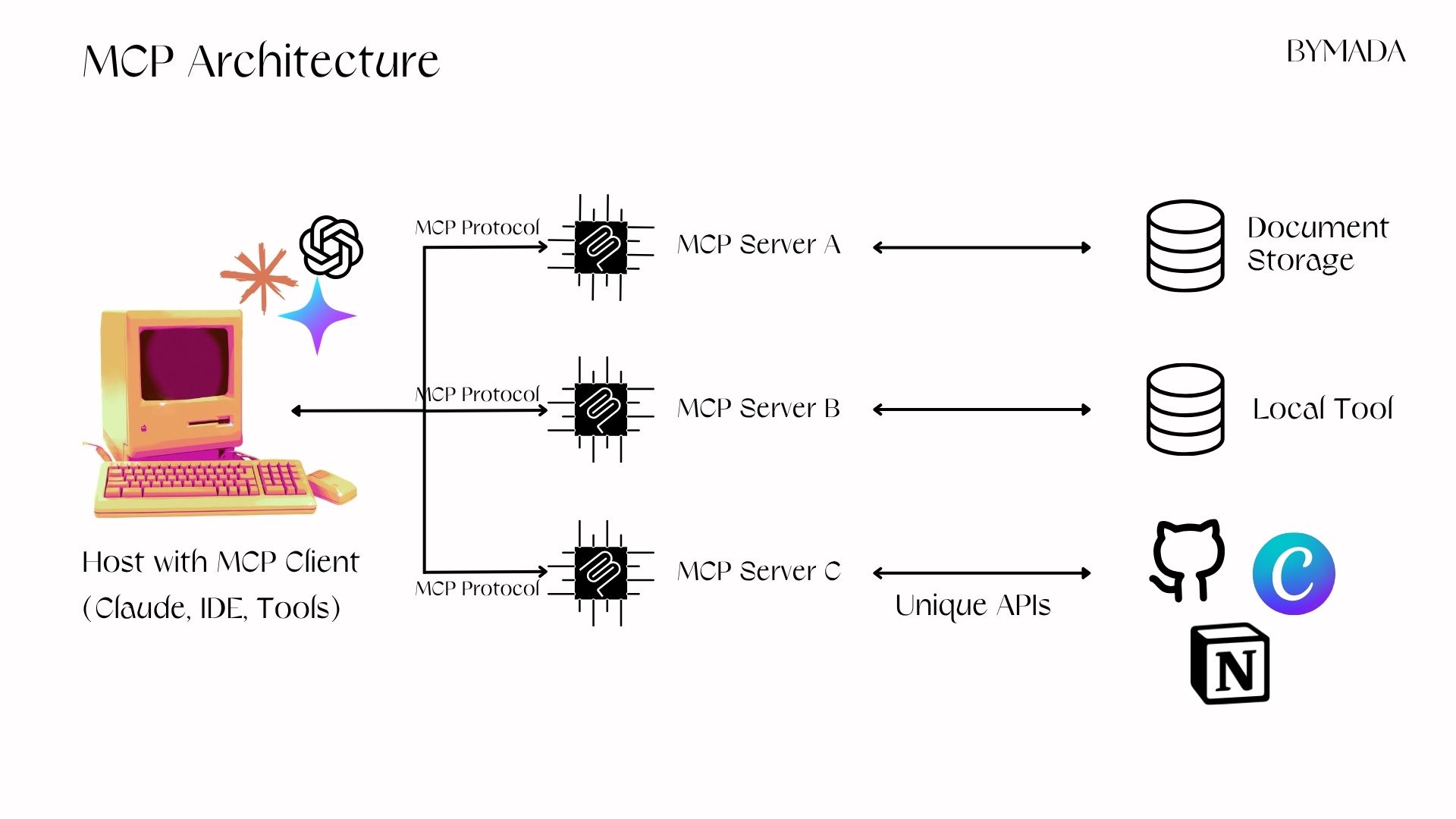
- Hosts : the AI application itself, like Claude Desktop or an AI-powered code editor. This is what the user actually interacts with.
- Clients : the go-between that manages the connection, translating requests from the host and relaying responses back.
- Servers : lightweight programs that expose a specific capability (a database, a file system, an API) through the MCP standard, and advertise what they can do.
MCP vs. RAG: not the same thing
Both MCP and Retrieval Augmented Generation (RAG) are ways of giving an LLM information beyond what it learned during training, but they solve different problems.
- RAG retrieves relevant documents or passages (say, from a policy library) to help the model answer a question more accurately.
- MCP lets the agent take live action checking real-time flight availability and actually making the booking, not just reading about flights.
Why this matters for businesses
MCP addresses practical pain points that have slowed down Agentic AI adoption:
- Less custom engineering. Instead of building a bespoke integration for every tool an agent needs, teams can build (or reuse) one MCP connector per tool, once.
- Better security posture. Connections go through a standardised layer with defined authentication and access control, rather than ad hoc, one-off implementations.
- Real-time context. Agents aren't limited to what they learned during training, they can pull live data and act on it immediately.
However, none of this is frictionless yet. A few real obstacles stand out:
Building Meaning
The crisis that started it
The semantic layer emerged from a real problem: any organisation with more than one database ended up with teams calculating "revenue" differently, analysts burning most of their time on data hygiene, and executives who couldn't trust a number that changed depending on who built the dashboard.
The fix was elegant: define metrics once, govern them centrally, let business users self-serve, and it worked for what it was built to do. Companies got consistent metric definitions and standardised reporting.
But we quietly assumed that solving calculation would also solve meaning. It didn't. Knowing that revenue formula, doesn't tell you why revenue dropped, which customers are at risk, or what to do about it. That gap isn't just one component; it's several, stacked on top of each other, and most of the confusion around "semantic layers vs. ontologies vs. knowledge graphs vs. AI context" comes from treating them as competing answers to the same question when they're actually answers to five different questions:
Measurement → Meaning → Why → What to do → Act
Each layer below adds one of these on top of what came before it. None of them replace the one before.
The open questions for 2026
01 Is there a middle ground? +
Efforts like the Open Semantic Interchange initiative (dbt Labs, Snowflake, Salesforce) are exploring "context-aware semantic layers." But YAML metric configs and formal ontology formats reflect fundamentally different theories of knowledge, the gap may be wider than a schema update can close.
02 Is metrics-first thinking over? +
The modern data stack assumed measurement was the foundation of understanding. AI systems don't reason that way; they need concepts and relationships, not charts.
Where this leaves us
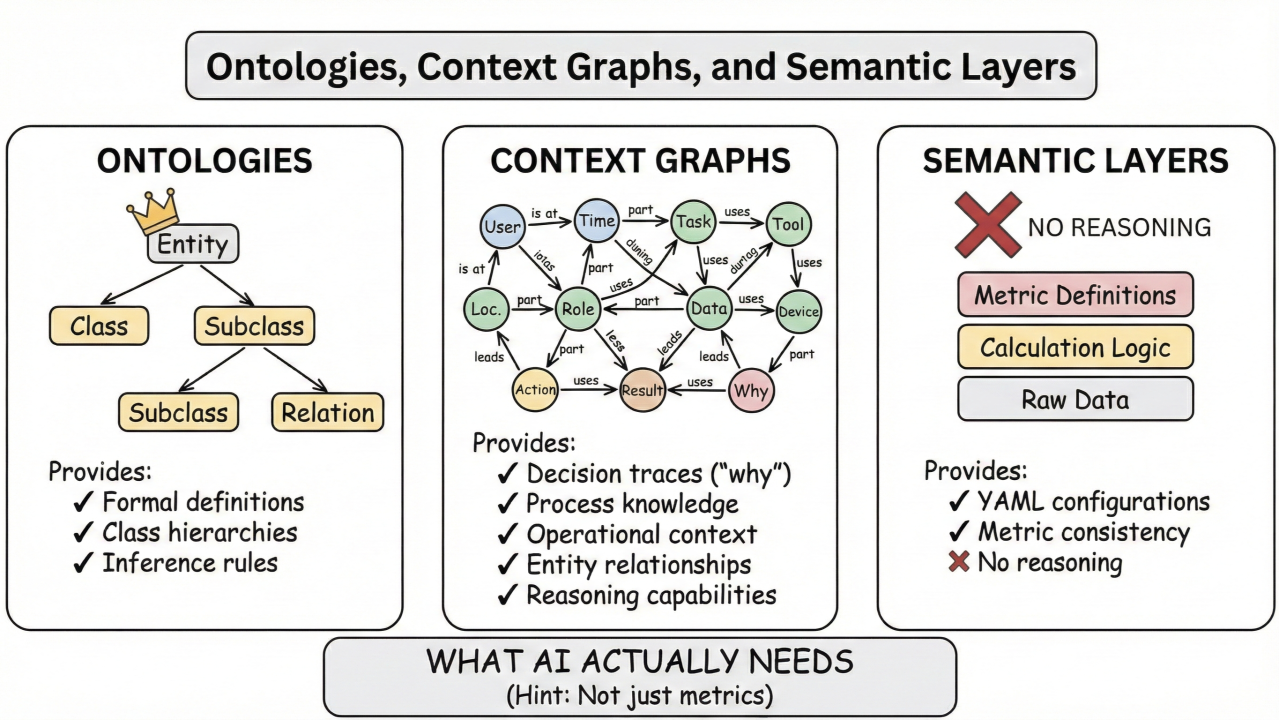
The "semantic layer vs. ontology" framing was always too narrow, and so is "ontology vs. knowledge graph" or "context graph vs. decision model." Each of these was built for a different question: measurement, meaning, why, what to do, act, and each stage still needs the ones beneath it. A semantic layer doesn't disappear once you have an ontology; an ontology doesn't disappear once you have a decision model; a decision model doesn't disappear once you have an agent. They stack.
AI is what's forcing the stack to become explicit. For metric lookup and basic analytics, semantic layers remain sufficient. For complex reasoning, inference, and domain-specific AI, they won't be, and the layers above them (ontology, context, decision intelligence, agent semantics) stop being optional.
Whatever we end up calling the whole stack (semantic layers 4.0, knowledge graphs, context engineering, the unicorn) the underlying need is the same: AI systems have to understand your domain's concepts, relationships, and constraints, not just its metrics. That's a knowledge architecture problem, closer to what librarians, taxonomists and knowledge engineers have done for decades than to what data teams do today.
Healthcare and life sciences started building this twenty years ago. Palantir built its own closed version in 2012. The question isn't whether the rest of us will eventually need it, it's who gets organised around it before their competitors do.
Token Maxxing: The new formula, ROI per Token
Token costs for some organisations double every 45 days while productivity gains plateau at 5%. Meanwhile per-token prices have collapsed: running a frontier model cost roughly $60 per million output tokens in 2023; by 2026, capable frontier models cost a fraction of that, and mid-tier models handle most enterprise work for under a dollar per million tokens.
Both things are true at once, and that's the puzzle. The cost of running an AI system reduces to one equation:
Cost = Price per token × Tokens per task
Every "AI just got cheaper" headline reports on the first variable. But if tokens-per-task rises faster than price-per-token falls, the bill still goes up, and that's exactly what's happening in most production systems today. The real cost story isn't pricing. It's architecture.
A hop became a pipeline
A 2024-style AI interaction was a single hop: prompt in, response out, maybe two thousand tokens, a couple of cents. A 2026 agentic workflow is a pipeline, an orchestrator decomposes the task, selects tools, calls a retrieval system, hands context to a sub-agent, validates the output, retries on failure, escalates to a different model, and assembles a response. Every step is a separate inference call, and every call re-reads context and re-emits tokens.
Research from Microsoft and Stanford's Digital Economy Lab found agentic tasks consume roughly 1,000x more tokens than a standard chat exchange. Cut the token price 75% and multiply consumption by 250, and the invoice still grows. It's the same dynamic as replacing a single database query with a distributed microservices system: each hop is individually cheap and collectively expensive.
Where the tokens actually go
Orchestration
Anthropic's own research reports multi-agent systems use roughly 15x the tokens of a simple chat call: a three-agent pipeline can burn ~29,000 tokens to do what one agent handles in 10,000. Most of that is coordination overhead: state and context re-synchronised at every handoff. In a five-agent system with fifty reasoning steps built on an 8,192-token planning document, naive context broadcasting alone can generate over two million tokens, almost all of it unchanged context, retransmitted because nothing deduplicated it.
Context accumulation
Agents are stateful: tool outputs, intermediate reasoning, and prior turns all carry forward into every subsequent call. A twenty-step reasoning trace can hit 50,000 tokens of accumulated history, past which the model spends more tokens re-reading its own past than reasoning about the current step. Across a multi-agent pipeline this compounds: a 50-message thread with four handoffs means the fifth agent processes ~200 messages, and cost scales quadratically with handoffs, not linearly. Microsoft's research adds a warning here: token usage on identical tasks varied up to 30x run to run, with no reliable link between higher usage and higher accuracy.
Retries and failure
Hallucinated tool schemas, reasoning loops, context overflow, misclassified severity, each triggers a retry with a now-larger context, and each ambiguous result may trigger another validation pass. None of this shows up in initial cost estimates because none of it was part of the design. Researchers call this the
Unreliability Tax
: the compute spent compensating for the uncertainty agentic systems introduce into what used to be deterministic pipelines. Pushing an agent from 80% to 95% reliability is mostly a token-cost problem, not a capability upgrade.
Model misallocation.
The most expensive problem is indiscrimination: defaulting to a frontier model for every task means a standard FAQ answer gets priced like a legal analysis. In early 2025, roughly 73% of enterprise token volume was routed to the two most expensive model tiers. A response that could run at $0.05/million tokens instead ran at $30/million, a 600-fold multiplier for identical output quality, simply because there was no routing layer.
The fix is architectural, not a pricing negotiation
Tokens as a design variable
What's emerging, unevenly, is a discipline that treats token consumption the way cloud architects learned to treat latency and data transfer: a first-class design variable, budgeted and attributed per workflow. That requires call-level instrumentation, cost attribution per team and workflow, a deliberate model-selection policy, and the organisational will to treat this as an engineering concern rather than an invoice-reconciliation task.
Current pricing is still partly underwritten by provider investment runways, and post-IPO economics may reprice the stack in ways that are hard to predict. But the structural dynamic underneath it — cheaper tokens enabling more complex architecture that consumes more tokens, isn't a temporary artifact. It's the trajectory of a technology getting more capable and more embedded at the same time.
The price per token dropped. The bill went up anyway. The second variable in the equation (tokens per task) matters exactly as much as the first, and building systems that keep it affordable is now the actual work.
The Tools that we like (and for some we use)
Eleven standout AI startups worth knowing, whatever the size of your team.
nao Labs
🇫🇷AI code editor for data teams, generates SQL and dbt models straight from your warehouse.
Lovable
🇸🇪Describe an app in plain English, get a working, deployed web app in minutes.
ElevenLabs
🇬🇧Realistic AI voice generation, cloning and dubbing for content and products.
Hugging Face
🇺🇸The open hub for AI models, datasets and libraries, home of the open-source ML community.
n8n
🇩🇪Node-based workflow automation to connect your apps and orchestrate AI agents, no code needed.
Claude / ChatGPT / Perplexity
🇺🇸The everyday AI assistants, research, writing and analysis in one chat window.
Suno
🇺🇸Type a prompt, get a full original song with vocals and instruments in seconds.
Canva
🇦🇺Drag-and-drop design platform, increasingly powered by AI image, writing and video tools.
Granola
🇬🇧A quiet AI notepad for meetings, turns rough notes into clean, shareable summaries.
Cusp AI
🇬🇧AI-driven materials discovery, a search engine for designing new molecules and materials.
Dust
🇫🇷Build and govern custom AI agents wired into your company's own tools and data.
2/ AI and Human Beings
A recent MIT Media Lab study reported that “excessive reliance on AI-driven solutions” may contribute to “cognitive atrophy” and shrinking of critical thinking abilities. While the study is still new and to be challenged, it delivers a warning that even AI assistants are willing to acknowledge. We asked Claude below.
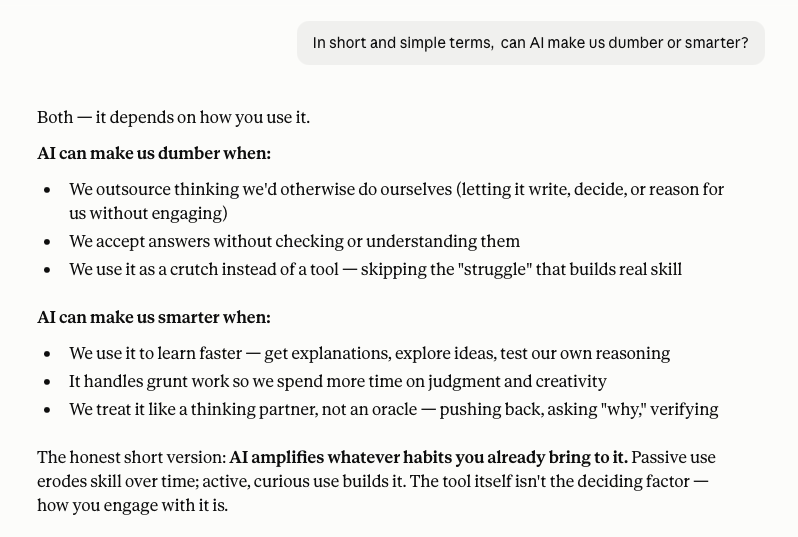
Since industrial era, we strive to reshape workflows by reducing the effort needed for basic tasks. However with Generative AI, the novelty is shifting cognitive demands toward verification, integration, and oversight. While it accelerates output and offers diverse stimuli for brainstorming, heavy reliance homogenise outputs, diminish original problem-solving, and lead to passive “intellectual tourism” where users merely validate machine suggestions.
We have to remember that AI machines work on sophisticated statistics, advanced mathematics, and use very fast electronic chips. They rely on data that has been created by humans, and that data is the same, more or less, across the different AI platforms. So when we ask a question to different AI platforms, most of the time their answers are very similar because the database is the same. AI can engage in processes that resemble critical thinking (data analysis, problem-solving, and modeling) but it has limitations. Critical thinking requires the human experience, the human insight, and ethics and moral reasoning. Machines today lack all of that, and their processes are only recursive.
AI at Work in 2026: Between productivity and the skills earthquake
In Q1 2026, two reports with unusually precise data caught my attention. On one side, Anthropic published its January 2026 Economic Index (an analysis of the economic primitives of real Claude usage) and then in March a dedicated study on the labor market impacts of AI , introducing a new framework for measuring professional exposure. On the other, the World Economic Forum published in January 2026 the testimonies of global decision-makers on how AI will transform work by industry , alongside its report Four Futures for Jobs in the New Economy: AI and Talent in 2030 .
Taken together, these works tell the same story from two complementary angles: what AI is already doing to our professions, and what it is preparing. For the first time, we have precise data on how AI is actually transforming our roles, far from the fantasies of total automation. Here are the key takeaways for understanding how the labor market is shifting.
Beyond Theory: Real Exposure ("Observed Exposure")
One of Anthropic’s major contributions is the concept of observed exposure ( observed exposure ). Rather than projecting what AI could theoretically automate, researchers measured what it actually does in millions of real professional interactions.
While 94% of computing-type tasks are theoretically automatable, Claude currently covers only 33% of tasks in that category in real-world usage. Legal constraints, human validation requirements, and the complexity of enterprise environments significantly slow adoption.
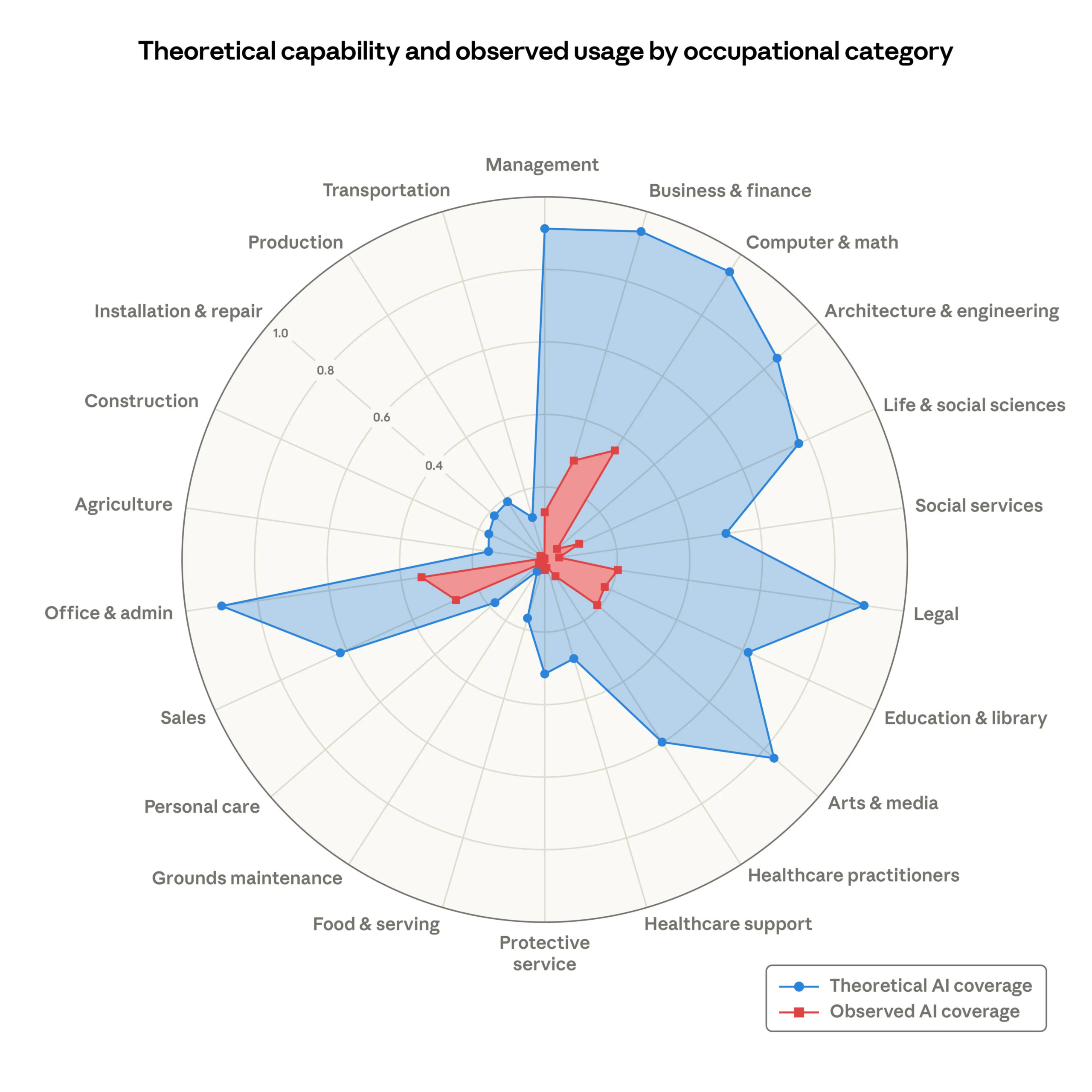
For organisations, overestimating this rate of automation leads to strategic errors: reorganizing too early, underinvesting in training , creating anxiety where clarity is needed. The real question is not «which jobs will disappear?» but «which tasks will evolve, and over what timeframe?»
The Education Paradox: The Most Qualified Are on the Front Line
Unlike previous industrial revolutions that hit manual occupations, AI is attacking the top of the skills pyramid. The Anthropic report is unequivocal: a diploma is no longer bulletproof. Data shows that the higher the education level a task requires, the stronger the AI acceleration: a university-level task benefits from an acceleration factor of 12x, versus 9x for a high school-level task.
Executives and highly-skilled profiles therefore see their most intellectual components absorbed first. This does not mean they will lose their jobs. It means their role will refocus on what models cannot yet do: validate, contextualise, decide under uncertainty. The AI success rate on complex tasks plateaus between 61% and 66%, making human expertise all the more indispensable for managing error margins.
What Global Decision-Makers Anticipate According to the WEF
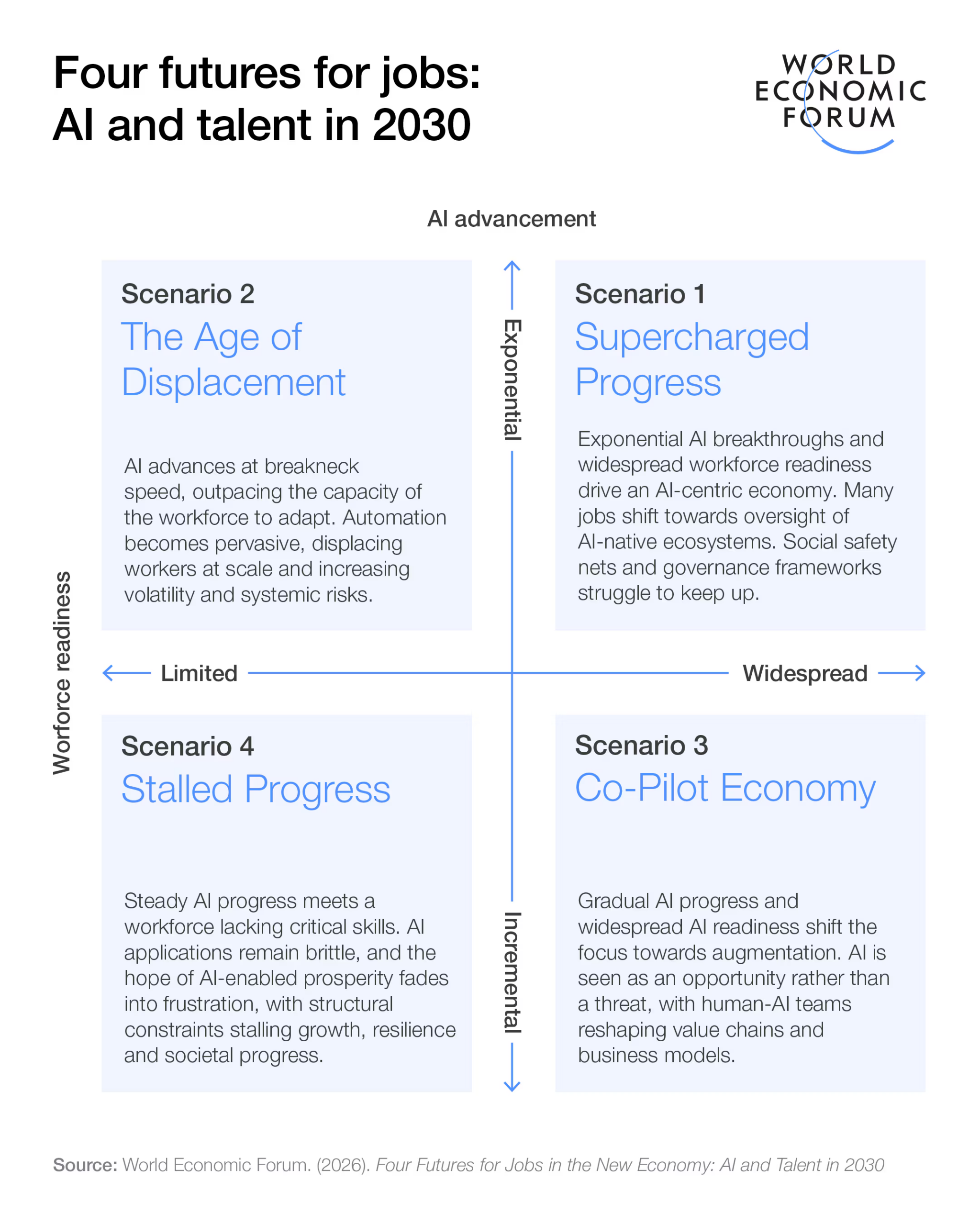
Where Anthropic measures present impact, the WEF questions those who are living it and anticipating it. In its January 2026 article gathering six major executives, the WEF outlines four possible trajectories for work through 2030: from successful human-AI synergies to scenarios where AI outpaces organisations’ capacity to adapt.
A consensus emerges from these testimonies: technology alone will not define the future of work. It is the decisions made today on training, talent strategy, and AI governance that will determine who comes out ahead. Gunter Beitinger (Siemens) puts it clearly: the decisive advantage will not come from automation alone, but from the ability to reconfigure entire workflows around human-AI collaboration.
The main risk identified by these executives is not AI itself: it is organisational inertia. Skills depreciate faster than traditional training models can absorb. Companies that integrate continuous learning as a performance metric will outperform those that do not.
While AI has not yet triggered a massive surge in global unemployment, a troubling «weak signal» is emerging: a slowdown in junior hiring. In the most AI-exposed professions, the entry rate for workers aged 22 to 25 has dropped 14% since 2022. Companies are beginning to use AI to absorb entry-level tasks, posing a major challenge for the training and onboarding of new graduates.
In the medium term, AI risks breaking the social mobility elevator for Gen Z, in an economy where work has historically been a path upward.
Augmentation vs. Automation: Humans Remain in Command
Despite the rapid advancement of model capabilities, Anthropic’s Economic Index data confirms that augmentation remains the dominant mode in real workplace situations:
| Mode | Definition | Share of usage |
|---|---|---|
| Augmentation | Human collaborates with AI, iterates and validates | 52% |
| Automation | AI executes the task end-to-end without intervention | 45% |
The user does not delegate, they drive. This resurgence of augmentation is linked to the evolution of tools: persistent memory and workflow personalisation, which favor the human-machine pairing over total delegation.
For organisations, this radically changes the nature of the investment required. It is no longer about buying a tool and waiting for it to work in place of teams, but developing a new way of working: formulating a precise request, evaluating the output, and iterating intelligently.
Last Words
The Anthropic report shows we are not facing a great replacement, but a profound restructuring. While AI frees up time on complex tasks, it also risks “de-skilling” certain professions by automating their most intellectual aspects.
The challenge for 2026? Learning to collaborate with these models (augmentation) rather than simply letting them do everything (automation). For companies, the challenge is no longer whether to use AI, but how to train their teams to remain in command.
Skills: The new currency of the AI-Era workforce
Something fundamental has shifted in how companies think about talent. Job titles are becoming less important; skills are becoming the real currency, and companies that haven’t yet worked that out are already falling behind.
The shift from roles to skills isn’t just an HR trend: it’s a direct response to the pace of technological change. When AI can automate a task that used to define someone’s job, what matters is whether that person has the adjacent skills to pivot, adapt, and contribute in new ways. Large companies are waking up to the fact that rigid job descriptions create rigid workforces. And isn’t that exactly the wrong thing to have when the environment keeps changing and you’re trying to run a business for the long term?
Why Skills-First Thinking Wins
A skills-based approach makes it possible to identify critical gaps in talent development and company priorities (do we have bottlenecks in certain critical skills, where all the work falls on one person?), and to run genuine upskilling programmes rather than box-ticking training, all while avoiding duplication and overload.
At BYMADA, we’ve built our own Data & AI skills framework around the traditional pillars of data literacy, enhanced with soft skills, because we believe people are at the centre of everything a company does.
- Read with data : the ability to interpret data in various forms, such as graphs, charts, or reports.
- Work with data : the collection and production of data (for example, setting up an experiment or creating a survey to gather insights).
- Communicate with data : the ability to use data to tell a story or make a case, such as using customer data to build a business case for a new product.
- Reason with data : navigating ambiguity with data and using it to drive business decisions.
- Lead with data : the ability to drive change and a data culture across the organisation, improving data usage for both individuals and project delivery.
One thing remains true throughout: modularity and cross-checking roles stay essential in this constantly evolving job and project landscape. No single skills framework is best for everyone in the market, it has to fit your organisation’s Data & AI strategy, its principles, and its ethics.
Grounding Principles for Skill Development - What actually works
The Learning Ecosystem Model
KPMG frames organisational learning not as a programme but as an ecosystem: a living system of interdependent components. Learning opportunities should be relevant, timely, tailored to each learner’s needs, and woven seamlessly into business and HR applications. The components are:
- Business strategy : the nucleus that feeds and guides the entire ecosystem.
- Functions : the business activities within the ecosystem.
- Learning : diverse experiences drawn from inside and outside the organisation.
- Technology : the connective tissue that enables learning interactions at scale.
- Employee experience : relevant, timely, and tailored to individual learning needs.
- Data : the signals that identify learning priorities and evaluate effectiveness.
- Culture : the operating system underneath everything, the way things actually get done.
How to Actually Upskill
At BYMADA, we’ve tried several approaches across large and medium-sized companies. Here’s what actually works:
- Identify the personas within your workforce. Not everyone needs to know everything, and not everyone will be exposed to AI at the same level. Adapting content, objectives, and target behaviours makes the learning programme far more effective.
- Build AI literacy first, adapted to your context. Understand how large language models work, how to write clear prompts, and how to recognise errors and hallucinations. Not everyone needs to become a machine learning engineer, but everyone does need to understand the tools they’re working with, and how to use them within the company.
- Practise daily, not periodically. Use AI for real work: drafting notes, summarising documents, analysing data. Fluency comes from repetition, not courses, pick formats that get people hands-on fast.
- Microlearn with intent, don’t marathon. Short, targeted lessons that fit into an existing schedule beat three-day workshops that are forgotten by Thursday. The goal is behavioural change, not completion certificates.
- Anchor learning to the actual job. Apply AI to real problems in each person’s specific field. Generic exercises build generic familiarity; job-specific application builds genuine capability, and that’s what makes the impact of AI use more realistic and measurable.
New data roles to prep for an AI-transitioned world
Thinking about the future of our data teams
Every few years, the data industry manufactures a crisis about its workforce.
- In the 2010s, it was the rise of self-serve BI: "If business users can build their own dashboards, what happens to the analyst?"
- In the early 2020s, it was the Modern Data Stack: "If anyone can spin up a pipeline with three clicks, what happens to the data engineer?"
The issue was never whether these roles would survive, but what they would become. The AI conversation is following the same pattern, with higher stakes, at a speed we never saw. Some argue that data engineers will be obsolete within three years, that AI will write all the SQL, or that a single prompt engineer will replace an analytics team. Others argue that little will change because AI cannot understand business context and the fundamentals remain the same.
But why do data teams exist? What are they trying to solve, and for whom? The answer is not about the roles themselves, but the angle from which they solve the problem.
Get the right information, in the right form, to the right consumer, at the right time, in a way the consumer can trust and act on.
Traditionally:
- The data engineer owns form: pipelines, schemas, transformations, and infrastructure that makes data accessible and reliable.
- The analyst owns information and interpretation: the query, the question, and what the data means in context.
- The data scientist owns inference: drawing signal from noise and building models that reveal what raw data cannot.
- The data architect owns structure: designing the systems that make the other roles possible.
Historically, all of these roles assumed the consumer was human. Humans can tolerate ambiguity, ask follow-up questions, apply institutional knowledge, and use judgment when the data is incomplete.
AI agents cannot.
What Changed: The Arrival of the AI Consumer
AI agents are becoming active consumers of enterprise data. They query systems, invoke tools, take actions, and make decisions autonomously.
This is already happening. An inventory agent can query stock levels; a customer-communications agent can pull CRM data; a financial agent can query a warehouse, interpret the results, and act on them.
The crucial difference is that an agent does not stop because data is ambiguous. It uses the context available to it and continues at machine speed and scale. If that context is incomplete or wrong, the resulting error can propagate through an automated workflow before anyone notices.
That changes the requirements of the data stack. It was designed primarily for human consumers; it must now support machine consumers that require explicit meaning, reliable contracts, predictable quality, and auditable decisions.
The New Map: Roles the Agentic Era is creating
By the way, if you're curious about what's coming next, look into Palantir-style roles.
Other roles are shifting
The shift does not affect every role equally, but most existing roles can evolve rather than disappear.
- The Data Engineer is becoming a systems architect for agentic data infrastructure. Routine pipeline plumbing is increasingly automated. The higher-value work is designing systems for AI consumers, building metadata and contract infrastructure, and managing a stack that serves both humans and machines.
- The Data Analyst is becoming a decision intelligence specialist. Standard reporting and data retrieval are increasingly automated. The more valuable work is understanding which decisions need to be made, designing frameworks for those decisions, evaluating AI-generated analysis, and translating between business questions and data systems.
- The Data Scientist is bifurcating. One path moves toward ML Engineering: operationalising and maintaining models in production. The other moves toward decision science: applying statistical and causal thinking to determine whether AI-driven decisions actually produce the intended outcomes.
The common thread is that commodity work is being automated while judgment, context, architectural thinking, and accountability become more valuable.
The New Org Chart
The modern (current) data team was built primarily to serve analysts and business users. Its goal was a well-governed, accessible, high-quality data environment for good insights.
The new (agentic) data team must serve humans and machines simultaneously.
Its goal is a data environment where meaning is explicit, contracts are reliable, decisions are auditable, and AI agents can operate with a level of trust comparable to that expected from the best human analysts.
3/ AI and Business
Since end of 2025 and MCP protocol, we saw the shift from standard conversational assistants to enterprise AI agents (even for small business owners!!) and it represents a fundamental evolution from passive text generation to autonomous execution.
As we saw before, it is moving past manual prompts to deploy systems that handle goals, interact with internal software, and run 24/7 on automated schedules.
The Agentic AI Gap
Conference hype vs. enterprise reality — drag to see both sides (from Sadie's Newsletter • sadiestlawrence.substack.com)
- Siloed legacy systems
- Manual CSV exports
- Infrastructure bottlenecks
- Evaluation challenges
- Skills gap & resistance
- Seamless AI agent coordination
- Real-time data integration
- Autonomous multi-step workflows
- Intent-based computing
- Instant deployment & scaling
However, is it reeeeeally shipped?
We saw a huge hype and as always, there is an execution Gap: +90% of enterprise AI pilots never reach production or stays in POC state.
- To deploy agents effectively, people first need to know how to work without them. Building robust, documented and harmonised processes is a difficult task for large organisations.
- Data is not owned, documented and structured and people have difficulty with basic Data literacy. Companies that deploy AI use-cases at scale, are companies that delivers learnings and practices on both data fundamentals and preservation of human savoir-faire (domain expertise and soft skills such as creativity, critical thinking and ability to iterate, without loosing composure).
- Finally, the last barrier organisational. The difference comes down to adoption strategy and iteration culture. Successful transformations share one thing in common: HR is at the center of the conversation from day one and work hand in hand with all expertises, so the transformation provides the playbook and essence.
Global AI Regulation: Where we stand now
As of summer 2026, artificial intelligence regulation has moved from drafting to enforcement in most major economies. The European Union's AI Act entered its most consequential phase yet, the United States solidified a security-focused (rather than comprehensive) federal approach, and China, the UK, and Canada each advanced distinct models of oversight.
Future of regulations will be political and how governments will treat frontier AI models as a national-security concern in their own right.
At a Glance
Hover or tap a highlighted country to see its AI regulatory framework.
What companies are doing now
For any company assessing exposure, the practical starting point is the same:
- Appoint an AI lead (not necessarily a technical expert, but a credible, legitimate sponsor).
- Inventory every tool or process that uses AI (including for existing vendors), whether officially approved or "shadow" use. Set up a lightweight oversight system (a shared dashboard for example).
- Classify each item against the relevant frameworks, starting with the EU AI Act due to its active and extraterritorial scope.
- Define a clear policy on approved tools, avoiding both extremes (banning everything creates dangerous shadow tech; allowing everything creates security chaos).
- Build in security safeguards by design: security committee review for every new deployment, and a formal ban on sending source code to unsecured public LLMs, etc.
As with GDPR before it, tooling to support this kind of use-case review and classification is now emerging; building that inventory is the necessary first step before any compliance program can function.
Summer drama for Anthropic

The tensions reached a boiling point in June following Anthropic's launch of its frontier flagship model, Claude Fable 5 (part of its Mythos class).
Days after its release, the US Commerce Department issued an unprecedented emergency export control directive ordering Anthropic to immediately ban all foreign nationals (whether abroad or inside the U.S.) from accessing the system. The government justified the move by pointing to a "narrow, non-universal jailbreak" that could allegedly allow foreign adversaries to exploit software vulnerabilities.
Lacking the infrastructure to instantly verify user nationality in real time to meet federal compliance, Anthropic was forced to pull the plug entirely, abruptly shutting down access to Fable 5 and Mythos 5 for all customers worldwide. Critics widely condemned the maneuver as a heavy-handed, weaponised deployment of export controls aimed at forcing an uncooperative AI lab into submission, though Anthropic ultimately complied under protest and restored global access weeks later after working with federal agencies to update its safety classifiers.
Use cases we love
A few of our favorite use cases. Caveat: most of the AI agent use cases developed today are assistants.
Rethinking Data Governance for the AI era
Data governance is usually seen as a burden: slow, bureaucratic, disconnected in an ivory tower. Yet it has gained new popularity, treated as indispensable now that AI and autonomous agents are embedded into core operations. That tension comes from a mismatch between how governance is designed and how modern systems actually behave, but it also comes from a mismatch in what governance is for. Rules and standards were never the point. Trust was always the point: making sure data is good enough, understood and protected well enough, so people and machines alike can act on it with confidence. Everything below is really a question of how that trust gets built, and how it breaks.
Why are we stuck with current data governance frameworks?
Traditional data governance assumes data has inherent, stable meaning that can be defined once, standardised, and owned singularly. That works perfectly well in small, centralised ecosystems.
Why? Data doesn’t mean anything by itself. Its meaning depends on who’s using it and why. A client’s “status” field might mean one thing to sales, another to billing, another to legal. Same data, different meaning, depending on context. And that context keeps shifting as the data moves between teams, systems, and purposes.
So, in a contained system, “set the rule once” can work. But in heavily distributed environments, where the same data gets created in one place and reused many others for many different purposes, meaning can’t be nailed down once and left alone. It has to be continuously negotiated, and so does trust. Trust in data isn’t a definition certified in a data catalogue tool you do once; it’s a property that has to hold up every time the data is reused somewhere by someone new.
Newer tools have gotten really good at automating that same old approach: enforcing rules faster (quality, access, classification) at bigger scale. But automation just makes the same flawed assumption run faster. It doesn’t fix the assumption itself, and it doesn’t manufacture trust. It just moves untrustworthy data more efficiently. This is why our current ways of doing data governance are not sufficient, automated or not.
Why AI accelerates the failure
As we have written before, generative AI systems are probabilistic and increasingly autonomous. When meaning is underspecified, the machine still acts.
This is where hallucination, bias, drift, and opacity appear, and they aren’t just technical bugs. They’re what happens when the meaning problem meets a system that can’t pause to ask. And crucially, they are also what happens when a trust problem in the data layer gets inherited (and amplified) by the AI layer sitting on top of it. Most AI initiatives that underdeliver or get quietly archived don’t fail because the model was weak; they fail because the data feeding it couldn’t be trusted in the first place, and nobody caught that until the output was already in front of a customer or a regulator. Skip the foundational work, and you don’t avoid the problem; you automate the errors, amplify the bias, and erode confidence in the very systems you built to save time.
Because decisions and processes are accelerating, governance models built on retrospective review or human-in-the-loop approval are structurally too slow to catch this in time.
So, AI governance isn’t a new problem; it’s the same governance problem, arriving faster, at greater scale, with less room to catch it after the fact. To match the speed, we need to invest in context building, embedding ethics, and maintaining accountability over the data and systems, even the ones generated by the AI itself. That means being able to answer, continuously, not just once:
- Do we know how to use outputs, and where are the boundaries?
- Should this system exist in the first place?
- Are we able to maintain accountability continuously?
- Would we be comfortable acting on this data if we had to explain that decision to the person it affects?
For autonomous systems, this shifts accountability from periodic review to continuous assurance: real-time observability and feedback loops that let responsibility be exercised before harm happens, not after, and that let trust be verified continuously, rather than assumed once and forgotten.
From human-led to human-directed
Despite the technology shifting underneath it, governance’s core job hasn’t changed: data governance is the people-based system by which data assets of the right quality are protected and shared with the right person at the right time, for achieving a defined purpose, so we can trust and act with confidence.
What’s changing is who’s asking for that data. Consumers will be both humans and machines, at the same time. As such, governance itself needs to become computable: intent, constraints, and accountability encoded directly into contracts, policies, and controls that platforms and agents can execute consistently; not as a replacement for human judgment, but as its extension.
Current data governance models depend on human compliance, documentation, and incentives; that doesn’t scale once decisions execute autonomously. Newer, more automated models improve speed and decentralisation but still assume stable meaning and accountability, which breaks the moment systems start acting on their own at runtime.
The shift, then, is a division of labour:
- People keep what can’t be delegated: negotiating what things mean, setting direction, owning outcomes, and cultivating the culture of stewardship that makes trust something people actually practise, not just something written into a policy document.
- Machines take on enforcement: monitoring behaviour, triggering escalations, feeding signals back so governance can adapt over time instead of being fixed upfront.
Trust is the destination, not a by-product
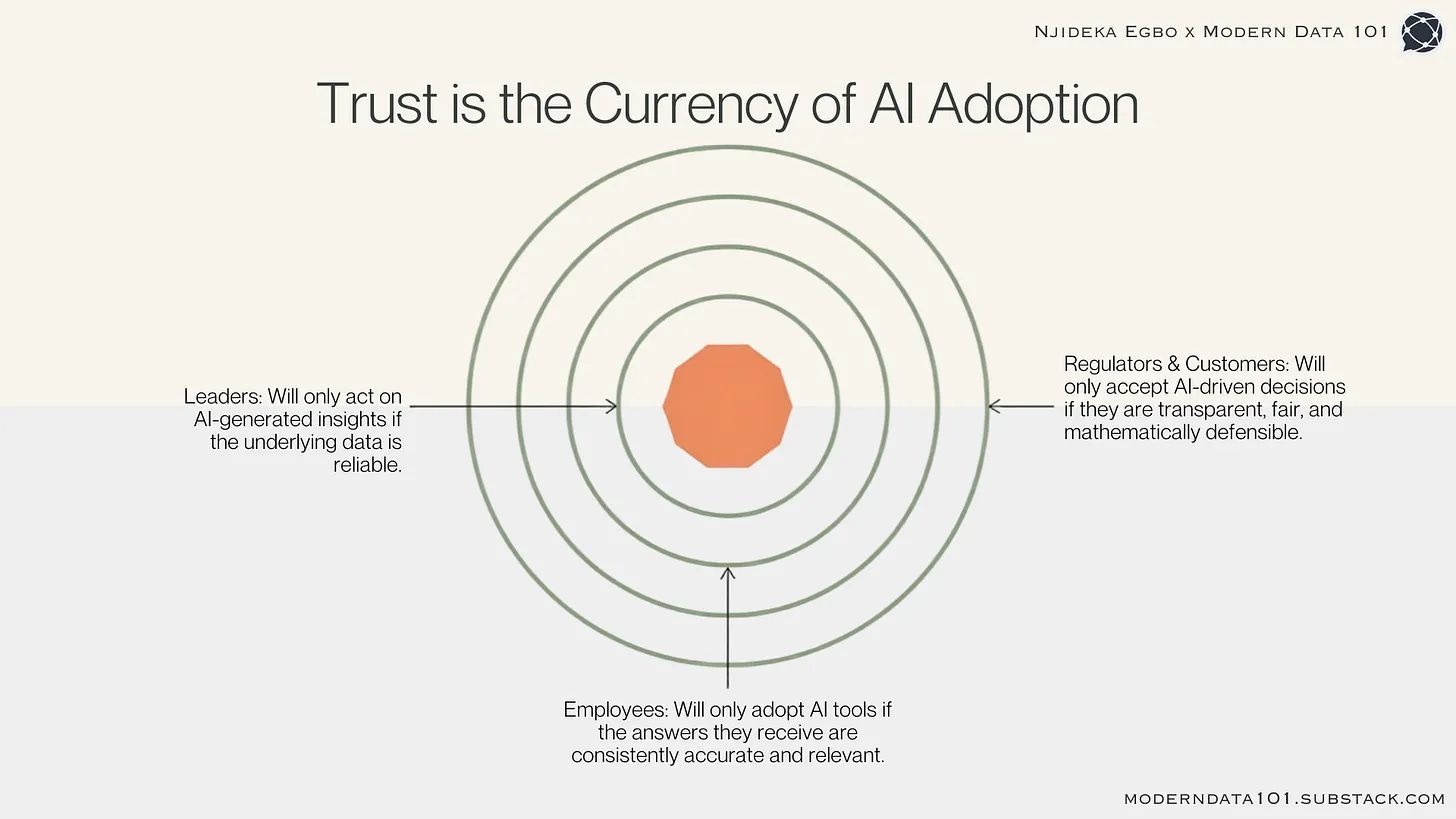
Trust isn’t a nice-to-have that falls out of good governance. It’s the point of governance. Data only creates value when it’s trusted (when it’s accurate, well-governed, secure, accessible, and understood by whoever, or whatever, is using it next). An AI system built on data nobody quite trusts will, at best, produce outputs nobody quite trusts either. Confidence doesn’t materialise at the model layer; it’s inherited, or it’s absent, from the data layer beneath it.
That’s also why this can’t be solved by rules and controls alone. Stewardship (people who feel genuinely responsible for the data passing through their hands, not just compliant with the checklist attached to it) is what turns governance from a constraint into a source of confidence.
4/ A practical checklist to start
You made it to the end: THANK YOU. Here are 7 actions you can take right now to bring AI into your work or personal life, responsibly. And stick around for the last section to learn more about us and how to reach us, we would love to receive your feedback and continue the conversation together.
01 Automate your meeting notes +
Install Granola (Teams or an equivalent) for your next meetings. Zero change in habits, visible results within a day.
- Tool: Granola / notetaking AI
- Effort: 5-minute setup
- Quick recommendation: always double check notes immediatly. You can also prompt the notes to have them in a favored format and style.
02 Target the Excel file nobody dares to touch +
Have its logic audited by a tool like nao Labs or by Claude/ChatGPT, and ask for a modernised version.
- Tool: nao Labs, Claude, ChatGPT - careful in not inputting confidential data!
- Deliverable: audit + modernised version
- Quick recommendation: you can use AI to brainstorm, but ask yourself what you are exactly trying to achieve: modernisation, simplification, better process, better data, etc.
03 Build an agent connected to your own data +
Try Dust or a custom GPT connected to your Drive on one specific task.
- Tool: Dust, custom GPT
- Scope: one specific and simple task like cleaning folders
04 Create a project status slide-deck and automate it +
Take a weekly project status, and automate the updates to generate your next update.
- Tool: Copilot, Claude
- Measure time saved (like copy-paste) for doing vs time spent
05 Turn vibe coding into a training ground +
Give a non-developer (marketing, HR, finance) access to Lovable to build a small internal app.
- Tool: Lovable, Claude Code, Codex etc.
- Measure: real-world time-to-use and POC ideas
06 Train to understand what is AI and how it works +
For all, understand conceptually all types of AI and what each can and can’t do — the goal is to build the awareness needed to manage risk.
- Audience: everyone, all levels
- Record the training in Annual Performance to encourage it
07 Appoint an AI Lead point of contact +
One small team (cross-functional role, not legal alone — not necessarily full-time) to track regulatory obligations on high-risk use cases.
- Framework: EU AI Act, implementation phase
- Ideally, before go-live, not after
- Write down your questions, who is involved, and your process, so you can repeat and improve for the next use case
5/ About BYMADA
Who are we?
An independent Toulouse-based studio, working wherever our clients take us.
We transform your data and projects into strategic assets. Every collaboration is bespoke and goes far beyond a simple service: it's a creative partnership where your vision meets our expertise.
Driven by curiosity, for the past year we've been exploring video production, motion design, and generative AI applications. These innovations expand our creative palette to better serve you, today and tomorrow.
What we do
- The Studio: Video creation, motion design, communication assets.
- The Academy: Creating custom learnings.
- Consulting Services: Data Office strategy, project deployment.
6/ Sources
The articles, reports, and statements referenced throughout this ebook.
- The Evolution of Ontology: From Formal Semantics to Knowledge Graphs, Decisions, and AI Agents — Joshua Yu, Medium
- The Token Price Collapse (and Why AI Costs Still Increase) — GTM Now
- How Do AI Agents Spend Your Money? Analyzing and Predicting Token Consumption in Agentic Coding Tasks — Microsoft Research & Stanford Digital Economy Lab
- Statement on the US government directive to suspend access to Fable 5 and Mythos 5 — Anthropic Newsroom
- Anthropic Pulls Its Most Powerful AI Models After U.S. Bars Foreign Access — TIME
- The Human Side of AI: Cultivating Stewardship and a Culture of Trust — Modern Data